
Why the Future Belongs to Teams, Not Tools
There’s a lot of noise right now about what AI can do for creative work.
Faster turnarounds.
More output.
Lower production costs.
All of that is true.
But speed and volume were never the real problem in creativity.
The real challenge has always been judgment.
Knowing what feels right.
Knowing what fits a brand.
Knowing what will land with a specific audience, in a specific market, at a specific moment
That’s not something you can scrape from data.
That comes from people.
Creativity Isn’t a Tool. It’s a Point of View.
Good creative work doesn’t start with software. It starts with perspective.
It comes from lived experience. From cultural awareness. From intuition. From understanding what your audience cares about, not just what an algorithm predicts they might click on.
A designer doesn’t just arrange shapes and colors. They make hundreds of tiny, invisible decisions:
What feels premium?
What feels trustworthy?
What feels too safe?
What feels off-brand?
Those decisions are where creativity really lives.
AI can generate options.
Humans decide what matters.
That difference sounds small. It isn’t.
Where AI Actually Helps (When Used Well)
Used properly, AI is incredibly useful in creative teams.
It speeds up the parts of the job that drain energy but don’t add much strategic value:
- Early drafts
- Variations and resizing
- Repetitive production work
- Quick explorations of directions
- Research and reference gathering
This gives designers back something that’s been in short supply for years: space to think.
Space to refine.
Space to experiment.
Space to push ideas further.
The best teams aren’t using AI to replace creativity. They’re using it to protect it.
The Risk of Letting AI Lead the Creative Process
When AI starts driving creative direction, something subtle happens.
Work becomes faster — but also more similar.
That’s because AI learns from what already exists. It’s great at remixing patterns. It’s not great at breaking them.
Over time, everything starts to feel familiar.
Clean.
Competent.
Predictable.
In branding and marketing, predictable is rarely a good thing.
Originality doesn’t come from patterns.It comes from people who decide to challenge them.
What Strong Creative Teams Are Figuring Out
The most effective teams right now aren’t obsessed with replacing designers.
They’re focused on making every good designer more powerful.
They let AI handle:
- The busy work
- The repetitive tasks
- The early rough passes
They rely on humans for:
- Creative direction
- Brand judgment
- Emotional resonance
- Cultural context
- Final decisions
That’s where real differentiation happens.
Not in how fast you can generate ideas.
But in how well you choose between them.
Why This Matters More Than Ever
As AI tools become more accessible, everyone will be able to produce “good enough” creative.
Templates.
Auto-generated visuals.
Quick-turn assets.
What will become harder to find is work that feels thoughtful. Work that feels intentional. Work that feels like it actually understands the brand and the audience.
That’s where human creativity becomes more valuable, not less.
The Future Isn’t Artificial. It’s Human-Led and AI-Supported.
The strongest creative advantage won’t come from choosing between humans and AI.
It will come from knowing how to blend them.
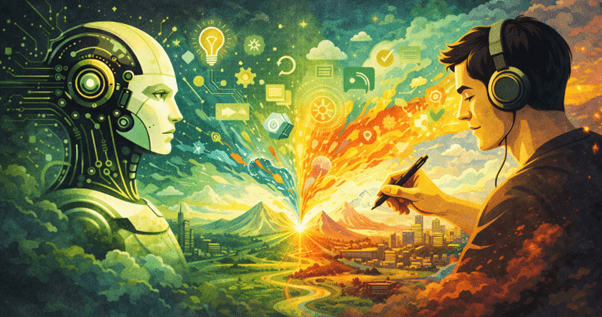
Human creativity sets the direction.AI accelerates the execution.
When that balance is right, creativity doesn’t get diluted.
It gets stronger.
Faster, yes.
But also smarter.
And more original.
A Practical Takeaway for Leaders
If your AI strategy is mainly about cutting creative headcount, you may save money.
But you’ll also limit how distinctive your work can be.
If your AI strategy is about giving creative teams better tools, more time, and more leverage, you build something far more valuable.
You build a system where creativity compounds.
And in a market where everyone has access to the same tools, that human edge is what actually stands out.
Discover how AI can empower your creative team .